
1. What is Fat Repositioning?
Fat repositioning mobilizes the herniated orbital fat without removing it and transposes it down into the hollow (tear-trough), producing a smooth, naturally graded under-eye contour.
Lower Blepharoplasty vs. Transconjunctival Fat Repositioning — the key difference is the incision location
Both procedures reposition the fat without removing it. The difference is where the incision is made.
Lower Blepharoplasty (transcutaneous)
- Incision through the skin (2–3 mm below the lash line)
- Fat repositioning + excision of redundant skin
- Scarring possible but in a low-keloid, well-healing zone
Transconjunctival Fat Repositioning
- Incision through the conjunctiva (inside the lid)
- Fat repositioning only (no skin excision)
- No visible scar (no external incision)
Why we don't simply remove fat
- Under-eye can sink, making the face look even older
- Dark circles can become more pronounced
- Loss of natural under-eye volume
Advantages of Fat Repositioning
- Addresses bulge and hollow in one step
- Preserves natural under-eye volume
- Improves dark-circle appearance
When needed — Concurrent Autologous Fat Grafting
When the bony hollow is significantly deeper than the available orbital fat, repositioning alone may not fully fill the recess. In these cases, combining fat repositioning with autologous fat grafting in the same session makes a meaningful difference. We discuss whether this is appropriate at consultation based on each patient's anatomy.
2. What is Lower Blepharoplasty?
Lower blepharoplasty always includes fat repositioning, and when there is significant skin laxity it also involves excising the redundant skin.
Because skin removal is required, the incision is made 2–3 mm below the lower lash line. This zone is known for low keloid formation and excellent wound healing, so visible scarring is not a major concern.
With age the orbital septum weakens and orbital fat herniates forward, producing visible bulges. Below these bulges the tissue sinks into a groove, casting a shadow that reads as a dark circle. Lower blepharoplasty addresses both the bulge and the hollow in a single procedure.
Our Philosophy — We do not remove the fat
At ROI, fat repositioning is always part of lower blepharoplasty. The exact technique varies widely between surgeons — some choose to remove the orbital fat.
Dr. Youngkee You does not remove the fat by default. With aging, the bony hollow underneath actually becomes more apparent, so rather than discarding this precious volume, we use the fat to fill the recessed area.
Why we reposition the fat — instead of removing it or using filler
Under-eye fat isn't something to “get rid of” — it's something to move and put to use. Here's why the two common alternatives — removing the fat, or filling the groove with filler — fall short.
① The limits of removing the fat
For a long time, removing under-eye fat was treated as the standard. But flattening the area by taking fat out is far harder than it sounds.
- ·Even a little too much leaves the area sunken and shadowed — often giving a tired, unwell look.
- ·Reducing the bulge does nothing for the tear trough groove beneath it, which stays put. Patients who come to us for revision often still have two ridges — the leftover bulge and the hollow groove.
Rather than forcing this natural change away, the goal of repositioning is to move the displaced fat into the hollow and smooth the step between them.
② The limits of filling with filler
It seems like you could just fill the groove with filler — but that groove isn't an empty space. It's formed by the tear trough ligament, a dense, tough band that tethers the skin inward.
- ·Filling “inside” that ligament is structurally difficult; the filler ends up spreading to either side of it. It may look better for a while, but it's rarely as fundamental as releasing the ligament and filling underneath with your own fat.
- ·Filler is said to dissolve completely over time, but what we see during surgery is different. When we operate on patients who had under-eye filler, in many cases the filler is still there or has turned into an altered, foreign-body-like material (even from 10 years earlier). Residual filler can block the lymphatic channels, making post-op swelling last much longer.
For these reasons, rather than “adding” something under the eye, ROI prefers to release the underlying ligament and fill the space naturally with your own fat.
Concerns Addressed by Lower Blepharoplasty
Herniated under-eye fat (bulge below the cheek roll)
Tear-trough groove (under-eye hollow)
Structural dark circles
Fine wrinkles and skin laxity under the eye
3. Our Signature Technique
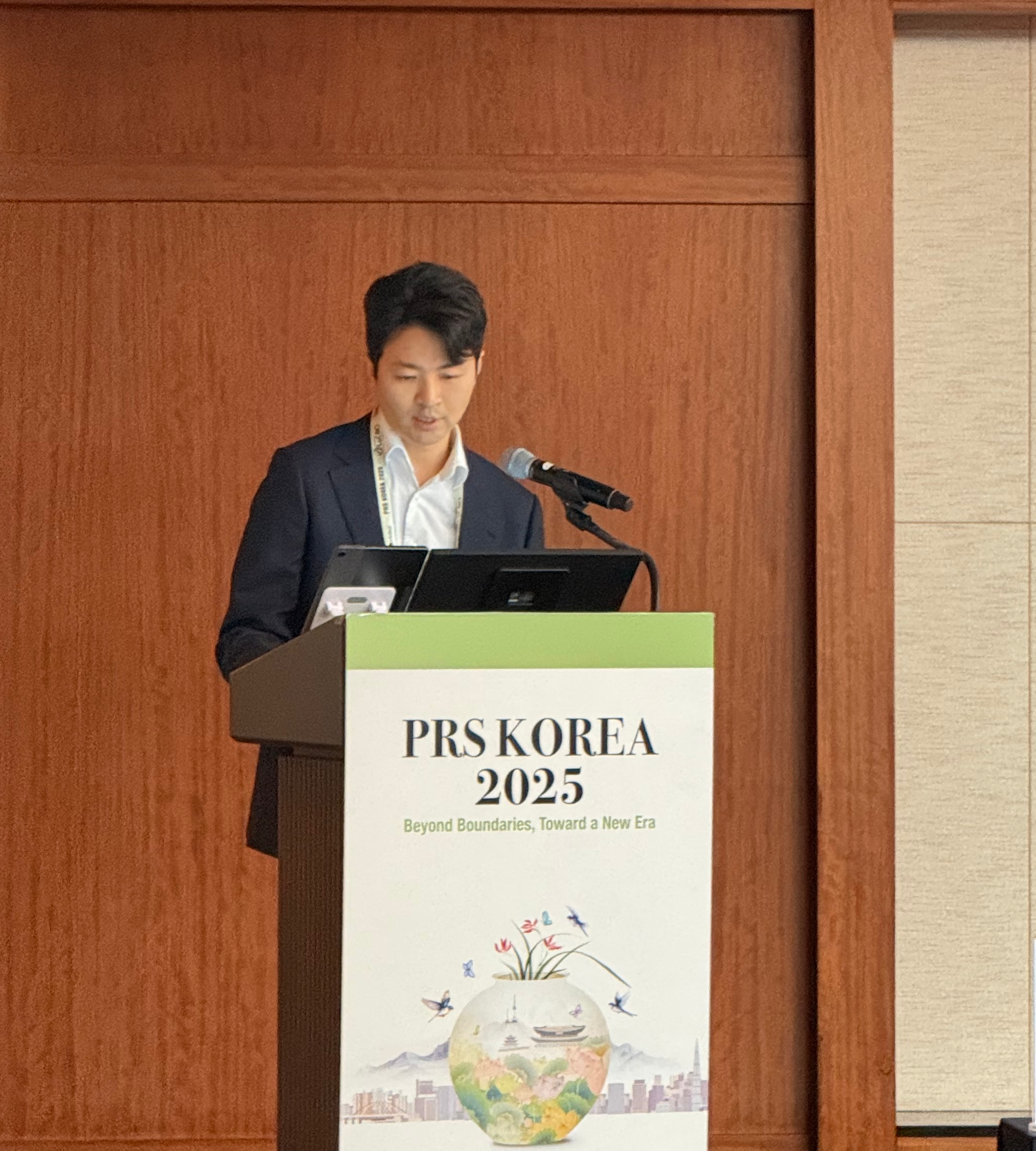
4-Point Continuous Fixation — presented at the 2025 Korean Society of Plastic Surgery (PRS)
ROI's real differentiator is "how and where the fat is fixed." Beyond simply moving fat, we perform thorough anatomic dissection and use an absorbable suture to fix the fat internally with a 4-point continuous technique that Dr. You developed in-house.
Complete tear-trough ligament release
The tear-trough ligament — the anatomic cause of the under-eye groove — is fully released to minimize the recess. Without sufficient release, repositioned fat cannot effectively obliterate the hollow.
Septum-attached fat dissection
Rather than isolating fat alone, we preserve the septal attachment. The septum is necessary for stable, long-lasting fixation.
Flat transposition over the bony recess
Fat is transposed and fixed only to the level just below the most prominent bony point — precise positioning. Too much volume causes recurrent bulging; too little leaves the hollow. Position is everything.
4-Point Continuous Internal Fixation with absorbable suture
Developed by Dr. You, this technique uses an absorbable suture for 4-point continuous internal fixation. Tension is distributed evenly, so the fat stays put as healing progresses.
Why the fixation method matters
Conventional (external bolster suture)
- Suture is removed at day 7
- At removal, adhesions are not yet sufficient
- Repositioned fat can migrate back out of place
- Long-term satisfaction tends to drop
ROI 4-Point Continuous Fixation
- Absorbable suture — no removal needed
- Internal fixation — stable through full adhesion
- 4-point even tension — fat stays where placed
- Superior long-term stability and satisfaction
2025 Korean Society of Plastic Surgery (PRS)
The 4-Point Continuous Fixation technique was presented by Dr. Youngkee You at the 2025 Korean PRS — peer-reviewed and recognized among Korean plastic surgeons.
PRS · Plastic and Reconstructive Surgery of Korea
4. Good Candidates
Bulging Under-Eye Fat
Patients whose under-eye fat herniates forward, creating visible bulges.
Pronounced Dark Circles
Patients with structural dark circles from a tear-trough groove who always look tired.
Under-Eye Wrinkles
Patients with skin laxity and fine lines under the eyes that contribute to an aged appearance.
5. Recovery Timeline
Suture removal — depends on the procedure
Transconjunctival Fat Repositioning
No suture removal needed — internal conjunctival closure, nothing to take out
Lower Blepharoplasty (transcutaneous)
Sutures removed on Day 7 — patient returns for removal of skin-incision sutures
Day of Surgery
Performed via the appropriate approach (transconjunctival or transcutaneous). Cold compression begins. Mild under-eye swelling and bruising are expected.
Early Recovery
Swelling gradually subsides. Bruising migrates downward and fades. Gentle washing is allowed.
Return to Daily Life + Suture Removal (transcutaneous only)
Most swelling and bruising are gone and easily covered with makeup. Patients who had transcutaneous lower blepharoplasty return at this point for suture removal. Transconjunctival fat repositioning patients do not require an additional visit.
Result Visible
Repositioned fat settles, revealing a smooth under-eye line. Fully settling can take 6 months or more, depending on the individual.
Before & After
※ Before & after photos are being prepared.
Note: More cases are available on Instagram @roisurgery.
Book Your Lower Blepharoplasty Consultation
If under-eye concerns make you look tired and older —
recover a smooth, refreshed under-eye line at ROI Plastic Surgery.